I CAN LIVE NO LONGER: The story of an indomitable man, the only volunteer to Auschwitz by Kowalski Jeremy
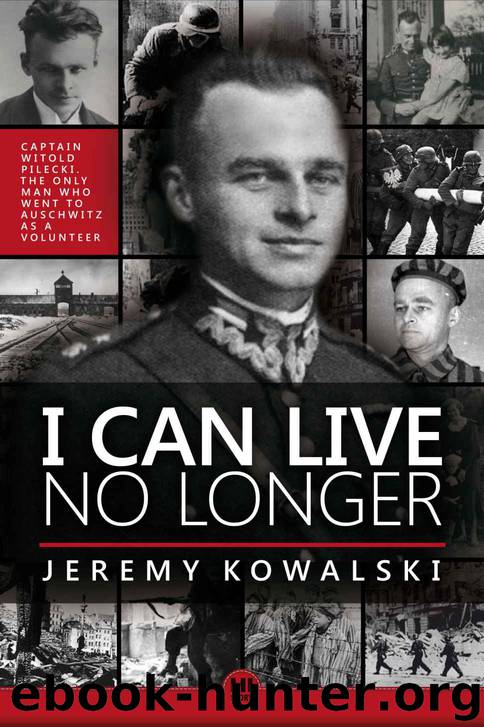
Author:Kowalski, Jeremy [Kowalski, Jeremy]
Language: eng
Format: epub
Publisher: HI Story
Published: 2013-04-24T00:00:00+00:00
Report from Hell
Witold was more resistant than the other prisoners to the hard conditions of life, and this was thanks to the self-discipline which he demanded of himself and those close to him. Witold was thus able to control the hunger pangs tearing at his insides, while his colleagues from his work commando went into a feeding frenzy on seeing a field of cabbage or beetroot. After stuffing their empty stomachs with raw vegetables, most of them suffered from diarrhoea and dysentery – some so badly that the SS would release them from the camp. Through the chimney. It was the same with the “meals” which all consisted of more or less disgusting liquids. On his very first day in the camp, Witold noticed the correlation between the amount of fluid ingested and the swellings on the bodies of the emaciated prisoners. In extreme cases, these swellings took the form of festering wounds, and the sick were swiftly disposed of with phenol injections. He decided, therefore, to take only one of the liquid meals – he drank the ersatz soup in the afternoon, and nothing more. He stuck to this principle even when hot, weak coffee was the only way to fight the cold. Most of his camp comrades could not allow themselves such sacrifices, just as they could not have allowed themselves to be sent voluntarily to the camp.
The British historian M. R. D. Foot, in his famous book “Six Faces of Courage”, of which Pilecki was one of the heroes, wrote that he was characterised by a hardness unattainable to ordinary people, so gallant that at first glance it seemed absurd. In his book Foot calls Captain Pilecki one of the world’s six most courageous people fighting in resistance movements during the occupation. And when he wrote it he knew of only a fraction of Pilecki’s actions.
There was one more reason why Witold could not simply die in the camp – he had come to form an underground camp organisation and help his fellow prisoners survive. He started to implement his plan from his very first days in Auschwitz, and in the course of two and a half years he created a 1,000-man camp resistance movement – the Union of Military Organisation (ZOW - Związek Organizacji Wojskowej). He organised it in a system of “fives”. He thought up the model of five-man cells, whose members did not know one another, even before he arrived at the camp. The first cell, or “top five”, was formed by Witold himself exclusively from trusted members of the Secret Polish Army, the TAP. This cell was to be led by Col. Dr Dering, who made the prison hospital where he worked as a “pfleger” (Poles could not be doctors, only nurses) into the nerve centre of the camp conspiracy. In some manner known only to himself, Dering arranged for medicines to be smuggled into the camp, although these were a drop in the ocean of what was needed.
The five-man cell system worked by members “at the top” creating further groups, and those forming yet more.
Download
This site does not store any files on its server. We only index and link to content provided by other sites. Please contact the content providers to delete copyright contents if any and email us, we'll remove relevant links or contents immediately.
| Africa | Americas |
| Arctic & Antarctica | Asia |
| Australia & Oceania | Europe |
| Middle East | Russia |
| United States | World |
| Ancient Civilizations | Military |
| Historical Study & Educational Resources |
Cecilia; Or, Memoirs of an Heiress — Volume 1 by Fanny Burney(32562)
Cecilia; Or, Memoirs of an Heiress — Volume 2 by Fanny Burney(31959)
Cecilia; Or, Memoirs of an Heiress — Volume 3 by Fanny Burney(31945)
The Secret History by Donna Tartt(19102)
Sapiens: A Brief History of Humankind by Yuval Noah Harari(14393)
Leonardo da Vinci by Walter Isaacson(13340)
The Radium Girls by Kate Moore(12034)
Sapiens by Yuval Noah Harari(5374)
How Democracies Die by Steven Levitsky & Daniel Ziblatt(5223)
The Wind in My Hair by Masih Alinejad(5100)
Homo Deus: A Brief History of Tomorrow by Yuval Noah Harari(4922)
Endurance: Shackleton's Incredible Voyage by Alfred Lansing(4787)
Man's Search for Meaning by Viktor Frankl(4608)
The Silk Roads by Peter Frankopan(4537)
Millionaire: The Philanderer, Gambler, and Duelist Who Invented Modern Finance by Janet Gleeson(4482)
The Rape of Nanking by Iris Chang(4218)
Joan of Arc by Mary Gordon(4116)
The Motorcycle Diaries by Ernesto Che Guevara(4105)
Stalin by Stephen Kotkin(3971)
